

By Cliff Montgomery – July 3rd, 2026
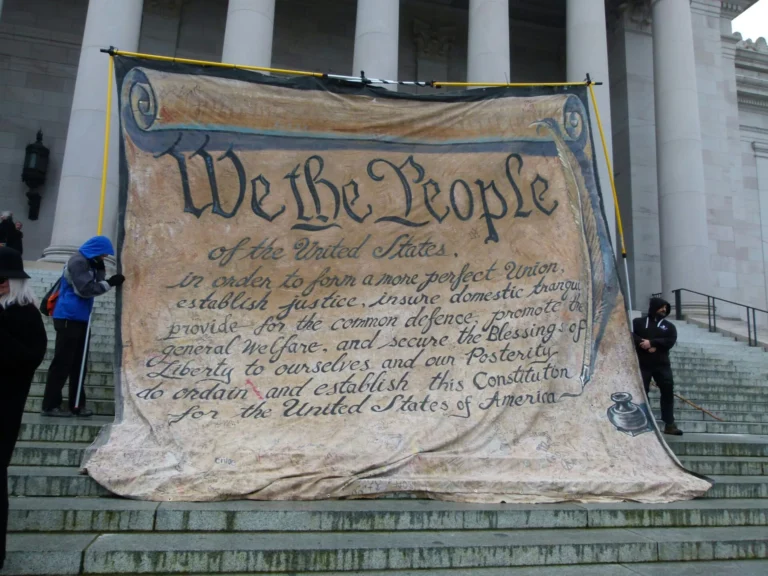
“For nearly a century, the Supreme Court has wrestled with the effects of technology on the privacy interests protected by the Fourth Amendment,” declares an article published Tuesday on Just Security that discusses a ruling that has upheld a citizen’s right to privacy in the digital age.
“That Amendment prohibits unreasonable searches or seizures of persons, houses, papers, and effects,” continues the article. “Yet it is undeniable,” states Just Security, “that technological advances enable the police to pry into formerly private areas in ways unimaginable to the drafters of the Bill of Rights.”
The modern digital age – with its near-ubiquitous digital collection of your most private information regarding your location, activity and your most immediate personal interests – may allow any interested party “to acquire private information without the type of physical search that would have been familiar to the framers in the late eighteenth century.” On occasion, those looking to gather such all-encompassing data may even include government officials.
Thankfully, “the Supreme Court has updated the Fourth Amendment to limit unrestrained police searches that draw on new technologies,” states Just Security, which includes “the vast amount of information accessible through smart phones.”
The article declares that “this week’s decision in Chatrie v. United States” maintains that realization. The Supreme Court ruled that the Fourth Amendment guarantees that government officials must prove before a judge that they are engaging in a reasonable search, and that normally those officials require a warrant that spells out what location data they may collect from a provider of computerized, digital services.
At the heart of the issue is the manner in which the officials obtained Chatrie’s location data. In order to discover the apparent whereabouts of people shortly before a credit union robbery, officials obtained a warrant that allowed them to grab and view the smart phone data of every user’s location within the general area of the credit union. The smart phone data – recorded by Google’s Location History – “records the location of a user’s cell phone every two minutes or so,” according to the Court’s ruling.
Shortly before the credit union robbery, eyewitnesses and surveillance recordings placed the apparent robber at “a corner of an adjacent church while appearing to talk on a cell phone.”
The warrant in question was employed to discover who was in the area during that general time frame.
“[T]hrough this process, Google ultimately produced three cell-phone users’ identifying information, including petitioner Okello Chatrie.” This ultimately led to Chatrie being charged with the crime.
The Supreme Court is allowing lower courts to determine whether the search warrant’s novel form of data collection is unconstitutional in any form. But it has flatly rejected the Trump Administration’s central claim that the data collected on all other smart phone users in the area was “a reasonable search and seizure.”
“The Government’s argument that accessing only a short amount of cell-phone location information does not count as a Fourth Amendment search fails,” declared the Court’s majority opinion.
It then quoted several previous Court rulings to further solidify its case. The ruling quoted previous findings which established that “ ‘[E]ven short-term monitoring’ can provide ‘a wealth of detail about [a person’s] familial, political, professional, religious, and sexual associations,’ ” and added that “this Court has never understood Fourth Amendment protections as kicking in only once an intrusion ‘goes too far.’ ”
As if the drive home its point, the recent ruling further declared that “[W]here the Fourth Amendment applies, it applies regardless of ‘the quality or quantity of information’ the government obtains.”
“The warrant issued here … was an uncommon, multi-step one,” declared the Court, “and the parties have contested the legality of each stage of the search process it authorized.” The Justices are allowing the Virginia “Court of Appeals to decide whether, at each step of the search process, the warrant satisfied the Fourth Amendment’s requirements of particularity and probable cause.”
Thus the Chatrie decision is a narrow iteration of government procedure, but its implications are enormous, especially with Donald Trump in the White House. In the ruling, the Supreme Court found that the Fourth Amendment demands government officials obtain a constitutionally valid search warrant to observe an individual’s movements.
Translation? Trump was denied the possibility of creating a government surveillance of every smart phone owner’s movements at every moment, without a hint of judicial oversight.
That would constitute some thorough bit of spying. According to Google, about 91% of people living in the U.S. own a smart phone – and, let’s add, they usually keep that phone on their person throughout the day. Therefore, this procedural decision quietly keeps Trump from maintaining a near-constant watch on the movements of most people in this country.
As Just Security succinctly pointed out, “the Court rejected that concept of a Fourth-Amendment-free zone,” by this ruling, judging that, “individuals have a reasonable expectation of privacy about their location when tracked by their cell phone.”
The Bill of Rights doesn’t cease to exist simply because the information is digital. Those rights remain valid. At least for now…